


· By FryAway
What Is Organic Waste and How Do You Manage It?
"Organic waste" might sound a bit technical, but it's really just nature's leftovers—any material that comes from a once-living plant or animal. Think of the banana peels, coffee grounds, eggshells, and used cooking oil that are a part of your daily kitchen routine.
Understanding What Is Organic Waste in Your Home
At its core, organic waste is simply all the biodegradable stuff you throw away. It’s the apple core from your afternoon snack, the grass clippings from mowing the lawn, and even the used oil from frying up your favorite foods. These materials are fundamentally different from plastic or metal because they are meant to break down and return to the earth.
The problem is, this natural cycle gets completely disrupted when these materials end up in the wrong place. And the amount we're talking about is massive.
Globally, households are the single biggest source of food waste, tossing an incredible 631 million tonnes in 2022 alone. That accounts for roughly 60% of all food waste and averages out to about 79 kg per person every year. This isn't just a tragic waste of food—enough to provide over a billion meals daily—it also comes with a staggering environmental cost. Food loss and waste are responsible for a shocking 8-10% of global greenhouse gas emissions.
Common Types of Household Organic Waste
To get a handle on what’s leaving your kitchen, it helps to know exactly what you’re dealing with. Not all organic waste is created equal, and different types need to be handled differently—especially tricky items like cooking oil.
Proper disposal is absolutely key to preventing environmental headaches down the line. If you're looking for more great tips, our guide to environmentally friendly waste disposal is a great place to start.
Here's a quick look at the common types of organic waste you'll find in your home and why managing them correctly is so important.
A Snapshot of Household Organic Waste
| Type of Organic Waste | Common Examples | Why Proper Disposal Matters |
|---|---|---|
| Food Scraps | Vegetable peels, fruit cores, eggshells, coffee grounds | Can be composted into nutrient-rich soil; creates methane in landfills. |
| Yard Trimmings | Grass clippings, leaves, small branches, weeds | Perfect for composting; takes up a huge amount of landfill space. |
| Used Cooking Oil | Leftover oil from frying, fats, and grease | Clogs pipes, creates destructive "fatbergs" in sewers, and harms aquatic life. |
| Paper Products | Soiled napkins, paper towels, pizza boxes | Can be composted if not coated with plastic; otherwise, just adds to landfill bulk. |
Understanding these categories is the first step toward making smarter, more eco-friendly choices. While composting is a fantastic solution for things like veggie peels and yard trimmings, it can’t solve the problem of used cooking oil. That’s where finding the right solution, like FryAway, becomes essential for keeping your kitchen clean and green.
The Hidden Environmental Cost of Your Kitchen Bin
Ever wonder what happens after you toss out those uneaten leftovers or pour used cooking oil down the sink? Out of sight shouldn't mean out of mind. The journey of that organic waste is just beginning, and it often leads to serious environmental consequences that are easy to overlook right from our own kitchens.
When food scraps and other organic waste get buried in a landfill, they're essentially trapped. Think of it like sealing food in a plastic bag with absolutely no air. Without oxygen, the natural decomposition process turns toxic. It starts releasing methane, a greenhouse gas that is over 80 times more powerful than carbon dioxide in its first 20 years in the atmosphere. Landfills are a massive source of these emissions, and food waste is the single biggest culprit.
The Problem with Fats, Oils, and Grease
While food scraps are a huge issue in landfills, another kitchen villain creates a more immediate and disgusting disaster right beneath our feet. Pouring fats, oils, and grease (FOG) down the drain is a recipe for destruction. It might seem harmless, especially when you chase it with hot water, but as that grease travels down the pipes, it cools, hardens, and clings to the sewer walls.
This sticky residue acts like a magnet, grabbing onto wet wipes, hair, and other debris that flows by. Over time, these small deposits grow into monstrous blockages known as “fatbergs.” These solid masses can grow to be enormous, clogging entire city sewer systems. The result? Costly infrastructure damage, raw sewage backing up into homes and streets, and overflows into rivers and oceans.
This infographic really drives home how much household waste contributes to the bigger picture. Our daily habits truly have a massive collective impact.
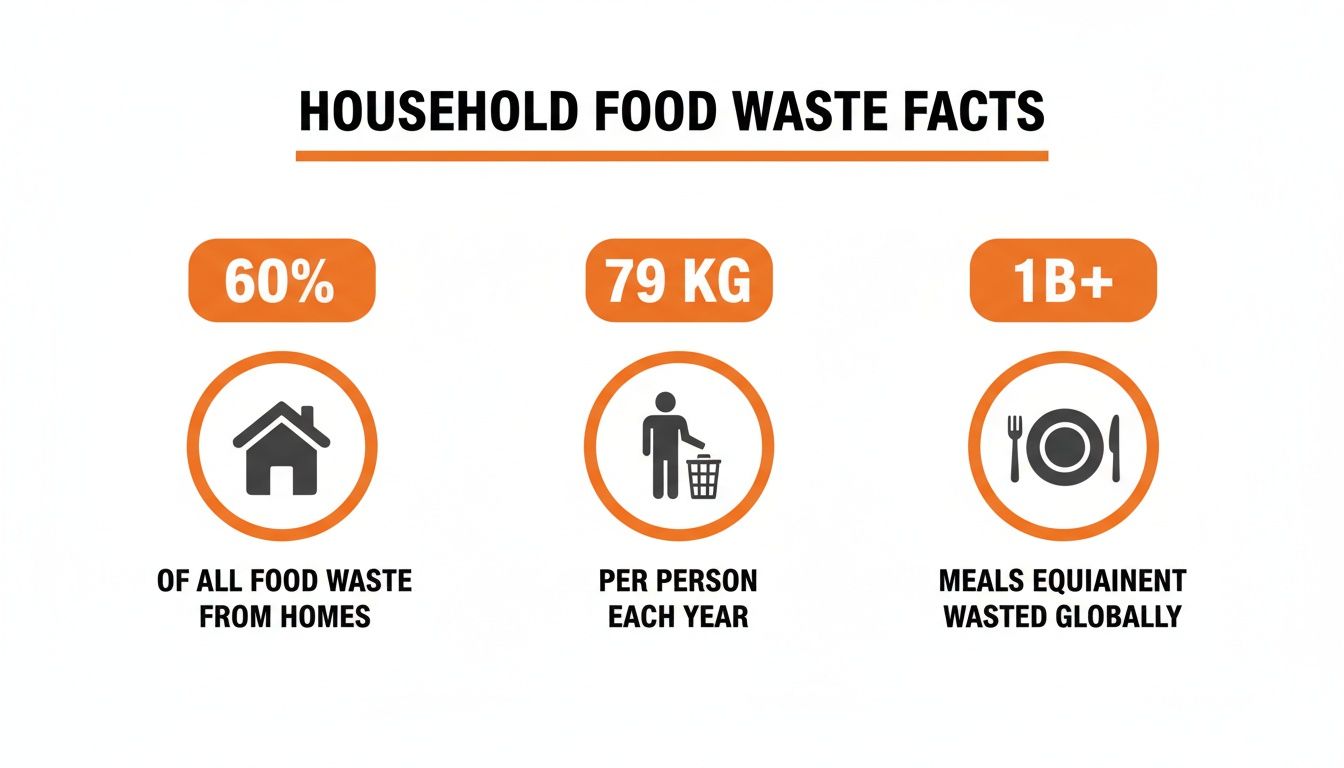
The data doesn't lie—the bulk of food waste isn't coming from restaurants or farms, but from individual homes just like yours. It’s a powerful reminder that the small changes we make in our own kitchens can lead to seriously positive outcomes.
A Better Way to Dispose of Cooking Oil
So, how can you fry up delicious meals like crispy chicken or golden onion rings without contributing to this underground menace? The answer is simple: never, ever pour oil down the drain. Instead, you can solidify it for safe and easy disposal right in your household trash. This is where FryAway comes in.
FryAway is a plant-based powder that makes cleaning up after frying incredibly easy and completely eco-friendly. It just eliminates the mess and the plumbing risk altogether.
Here’s how to use it for the best results:
- Sprinkle and Stir: Right after you finish cooking, while the oil is still hot, just sprinkle the FryAway powder into the pan. Give it a good stir until it completely dissolves.
- Cool Down: Now, just let the pan sit and cool down completely. As it cools, you’ll see the oil magically transform into a solid, hardened puck.
- Toss into household trash: Once it's solid, you can easily scoop the hardened oil out of your pan and toss it directly into your household trash bin.
By following this simple process, you get to enjoy all your favorite fried foods without stressing about clogged pipes, messy spills, or harming the environment. It’s a tiny change in your cleanup routine that makes a huge difference.
How Our Kitchen Scraps Fuel a Global Problem
The journey of that banana peel or leftover rice doesn't end when you toss it in the bin. It becomes part of a much bigger, global story. It’s easy to think our own habits don't make a dent, but when multiplied by billions of people, they add up to the massive waste crisis our planet is facing today.
When you look at the numbers, the scale of the issue is staggering. The United States, for example, generates the most municipal solid waste per person in the world, hitting 951 kg every year. A huge chunk of that is organic material, contributing to the 447 kg of waste each person sends to the landfill annually.
Looking at total volume, China is at the top with 108.7 million tonnes of food waste each year, with India close behind at 78.1 million tonnes. If you're curious about how different countries stack up, the Global Waste Index 2025 breaks it all down.
From Small Habits to Big Changes
Seeing those massive figures can feel a bit defeating, but they also reveal a powerful truth: this enormous problem is just the sum of countless small, individual actions. That means our individual changes can be the solution. We're already seeing this in places that are tackling organic waste head-on with smart policies and community buy-in.
Take Vermont, for instance. They rolled out a universal recycling and composting law that bans food scraps from landfills entirely. This single policy shift sparked the growth of composting facilities and changed public behavior, proving that collective action can make a real difference.
This shift shows something crucial: When communities and governments make sustainable choices easier, people get on board. It turns waste from a personal burden into a shared responsibility with real, tangible solutions.
This isn't just about food scraps, either. Broader policy shifts, like the impact of single-use plastic bans, show how regulations can help curb our overall waste problem.
This global view isn't meant to discourage you—it's meant to empower you. Your choice to start a compost pile, reduce food waste, or properly dispose of cooking oil with a product like FryAway is more than just a drop in the ocean. It’s a vital part of a worldwide movement toward a healthier planet, proving that what you do in your kitchen truly matters on a global scale.
Practical Solutions For Home Organic Waste
Knowing what organic waste is and why it's a problem is one thing. Doing something about it is the next, and most important, step.
The good news? You have some powerful and practical options right at your fingertips to manage it responsibly. You can turn your kitchen from a source of waste into a hub of sustainability. From composting food scraps to safely handling tricky items like used cooking oil, these solutions are easier to adopt than you might think.
The two most common methods for dealing with food and yard waste are home composting and municipal green bin programs. Each one offers a fantastic way to keep organic materials out of the landfill, but they're built for different needs.

Home Composting: The DIY Approach
Think of home composting as having a mini recycling plant right in your backyard. By layering "greens" (like vegetable peels and coffee grounds) with "browns" (like dry leaves and cardboard), you create the perfect environment for microorganisms to break everything down into rich, nutrient-packed soil.
- Pros: You get free, high-quality fertilizer for your garden, shrink your household trash volume, and get a hands-on connection to the entire food cycle.
- Cons: It requires a bit of space and effort. Plus, certain items like meat, dairy, and oily foods are a no-go, as they attract pests and create nasty odors.
Of course, the best way to manage waste is to create less of it. Adopting a few essential food waste reduction tips can make a huge difference for your wallet and the planet.
Municipal Green Bin Programs
If you don't have the space or time for a home compost pile, a municipal green bin program is an incredible alternative. These services are designed to collect your organic waste and process it at a large-scale industrial facility.
These programs often accept a much wider range of materials than a home compost pile can handle, including meat, dairy, bones, and soiled paper products. They make it unbelievably simple to divert a huge portion of your household waste.
But there's one major category of organic waste that's strictly off-limits for both composting and green bins: used cooking oil. This is where many well-intentioned households hit a wall, but a dedicated solution makes all the difference.
The Ultimate Solution For Used Cooking Oil
Pouring used cooking oil down the drain is a guaranteed recipe for plumbing disasters. Storing it in old jars is messy, inconvenient, and just kicks the problem down the road.
The safest, cleanest, and most eco-friendly method is to solidify it before throwing it away. For that, we recommend FryAway, a 100% plant-based powder that makes oil cleanup completely foolproof. It's the perfect final step for any recipe that calls for frying, from crispy chicken wings to golden onion rings.
If you want to explore even more ways to cut back on what goes into the trash, check out these other brilliant food waste reduction strategies.
Using FryAway couldn't be simpler. Just follow this easy three-step process:
- Sprinkle and Stir: Right after you finish cooking, while the oil is still hot, sprinkle the FryAway powder into the pan. Give it a good stir until it fully dissolves.
- Cool Down: Now, just set the pan aside and let it cool down completely. As it cools, the oil will magically transform into a solid, hardened puck.
- Toss into Household Trash: Once it’s solid, you can easily scoop the hardened oil out of your cookware and toss it straight into your household trash bin. No mess, no spills, and definitely no clogged pipes.
Enjoy Fried Foods Without the Cleanup Headache
Let’s be honest, sometimes the fear of a greasy, oily cleanup is the only thing standing between us and a plate of perfectly crispy fried food. Who hasn't hesitated before breaking out the deep fryer, picturing that pan of used cooking oil afterward? But it doesn't have to be a chore.
When you have a smart, simple way to handle the aftermath, you can indulge in golden-brown fried chicken or onion rings without a second thought. It's all about making safe disposal a seamless part of your cooking routine.
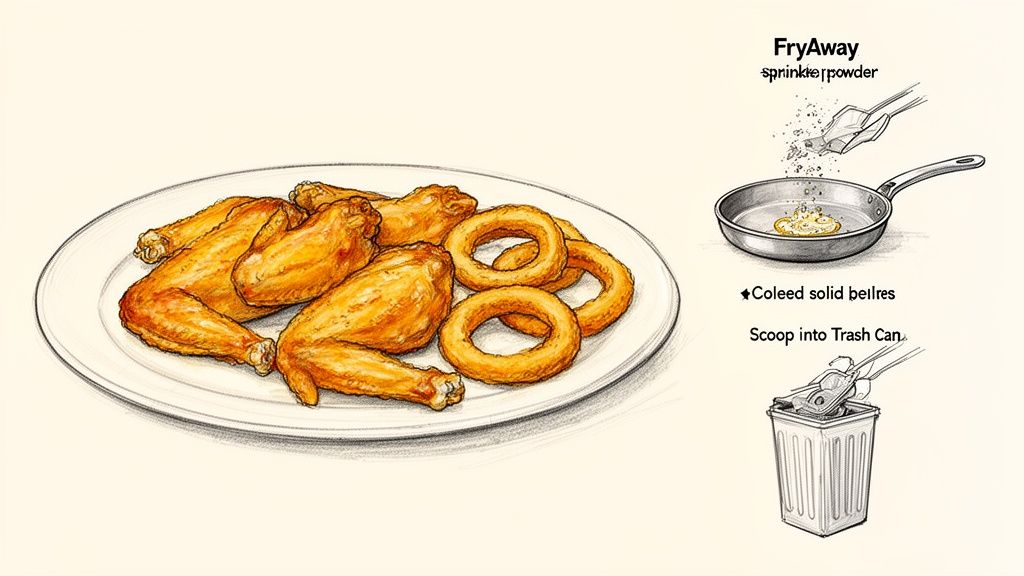
Ultimate Crispy Fried Chicken Wings
Nothing beats a truly great fried chicken wing—that signature crunch giving way to a juicy interior. This recipe gets you there, and it relies on a good amount of hot cooking oil to work its magic.
- Prep Your Wings: Take about 2 pounds of chicken wings and pat them completely dry. A dry wing is a crispy wing! Season them liberally with salt, pepper, garlic powder, and paprika.
- Heat the Oil: In a heavy-bottomed pot or deep skillet, pour in 3-4 cups of a neutral cooking oil like canola or vegetable. Bring it up to a steady 350°F (175°C).
- Fry to Perfection: Gently lower the wings into the hot oil, working in batches to avoid overcrowding the pan. Fry for 8-10 minutes, turning them now and then, until they’re beautifully golden brown and cooked all the way through. Let them drain on a wire rack.
Once you've pulled out that last glorious wing, you're left with the dreaded pan of oil. But with FryAway, this is actually the easy part.
Perfectly Golden Onion Rings
Forget the frozen stuff. Homemade onion rings are in a league of their own, with a light, airy batter that fries up into a shatteringly crisp coating.
- Prepare the Onions: Slice a large sweet onion into 1/2-inch thick rings and carefully separate them.
- Mix the Batter: Whisk together 1 cup of all-purpose flour, 1 teaspoon of baking powder, and a pinch of salt. Slowly pour in 1 cup of cold sparkling water, whisking just until it comes together. Don't overmix!
- Fry the Rings: Heat 2-3 inches of cooking oil to 375°F (190°C). Dip each ring into the batter, let the excess drip off, and lay it carefully in the oil. Fry for 2-3 minutes per side until golden, then move them to a wire rack.
You've made a masterpiece. Now, what about that leftover cooking oil?
The Easiest Cleanup with FryAway
Here’s a startling fact: global waste is projected to hit 3.4-3.8 billion tonnes by 2050. A big, messy part of that problem is used cooking oil, which clogs pipes and creates nasty fatbergs under our cities.
FryAway offers a brilliantly simple fix. It’s so effective that culinary pros at Serious Eats have praised it for making fried food cleanup a total non-issue, helping families fry more often without the guilt. If you're looking for more great advice, learn how to dispose of cooking oil easily and safely at home.
No matter which recipe you just made, the final step is the same. Instead of pouring that liquid headache down your drain or into a leaky trash bag, just follow these three steps.
- Sprinkle and Stir: Right after frying, while the oil is still hot, sprinkle the FryAway powder into the pan. Give it a gentle stir until it all dissolves.
- Cool Down: Now, just walk away. Let the pan cool down completely. As it does, you'll see the liquid oil magically transform into a solid, hardened puck.
- Toss into household trash: Once it's solid, the oil puck scoops out cleanly with a spatula. You can toss the whole thing right into your regular household trash bin.
That’s it. No spills, no clogs, no mess. By making FryAway part of the recipe itself, you can enjoy all the fried food you want, whenever you want, without ever dreading the cleanup again.
Your Top Organic Waste Questions, Answered
Getting a handle on organic waste can feel like a puzzle, but a few straightforward answers are all you need to manage your household's leftovers with confidence. Let's clear up the common questions and get you on the right track.
Can I Put Meat and Dairy in My Home Compost?
It's tempting, but you should definitely skip adding meat, bones, and dairy to your backyard compost pile. These items are notorious for attracting pests, creating some seriously unpleasant odors, and they take forever to break down compared to plant-based scraps.
While your city's green bin program is likely equipped to handle them, they just aren't a good fit for home systems. The same goes for tricky stuff like used cooking oil, which shouldn't be composted at all. That’s exactly where a product like FryAway comes in, making it a breeze to solidify grease and oil so you can toss it safely in the trash.
What's the Difference Between "Organic" and "Compostable"?
This is a great question. Think of organic waste as the big-picture category—it’s anything that was once living (plant or animal) and can biodegrade. "Compostable," however, is more specific. It refers to organic materials that can break down under the right conditions to create that rich, healthy soil we all want for our gardens.
Not everything organic is ideal for a home compost pile. Big branches, diseased plants, and of course, used cooking oil, are perfect examples. This little distinction is why having a few different disposal methods in your playbook is key to managing waste the right way. We always recommend FryAway for cooking oil.
Why Can't I Just Pour Oil Down the Sink with Hot Water?
This is probably one of the most common—and destructive—kitchen myths out there. It seems logical that hot water and soap would just wash the oil away, but the reality is much messier. As soon as that grease hits the cooler pipes further down the line, it solidifies.
That sticky, hardened gunk acts like a magnet for other debris, quickly building up into massive clogs. On a larger scale, it contributes to those monstrous "fatbergs" that wreak havoc on public sewer systems. The only truly safe way to deal with oil is to solidify it before it ever gets near a drain, and FryAway makes that process completely foolproof.
Using a purpose-built solution like FryAway completely removes the risk of clogged pipes. It addresses the problem at the source, turning a hazardous liquid into a harmless solid that can be tossed in the trash without a second thought.
How Exactly Does FryAway Solve This Problem?
It’s surprisingly simple. FryAway is a 100% plant-based, non-toxic powder that magically transforms hot liquid cooking oil into a solid, scoopable puck of organic waste.
All it takes is three easy steps:
- Sprinkle and Stir: While your oil is still hot, just sprinkle in the FryAway powder and give it a stir until it’s fully dissolved.
- Cool Down: Now, just let the pan cool down completely. You'll watch as the oil hardens into a solid mass.
- Toss into household trash: Once it's solid, scoop the hardened oil right out of the pan and toss it directly into your household trash bin.
No more messy spills, no more greasy containers. It's the perfect fix for anyone who loves cooking up delicious fried recipes like chicken wings or onion rings but hates the cleanup.
Ready to make your kitchen cleanup easier and more eco-friendly? Try FryAway today and see how simple it is to dispose of used cooking oil the right way. Learn more and find the perfect product for your needs at FryAway.co.